

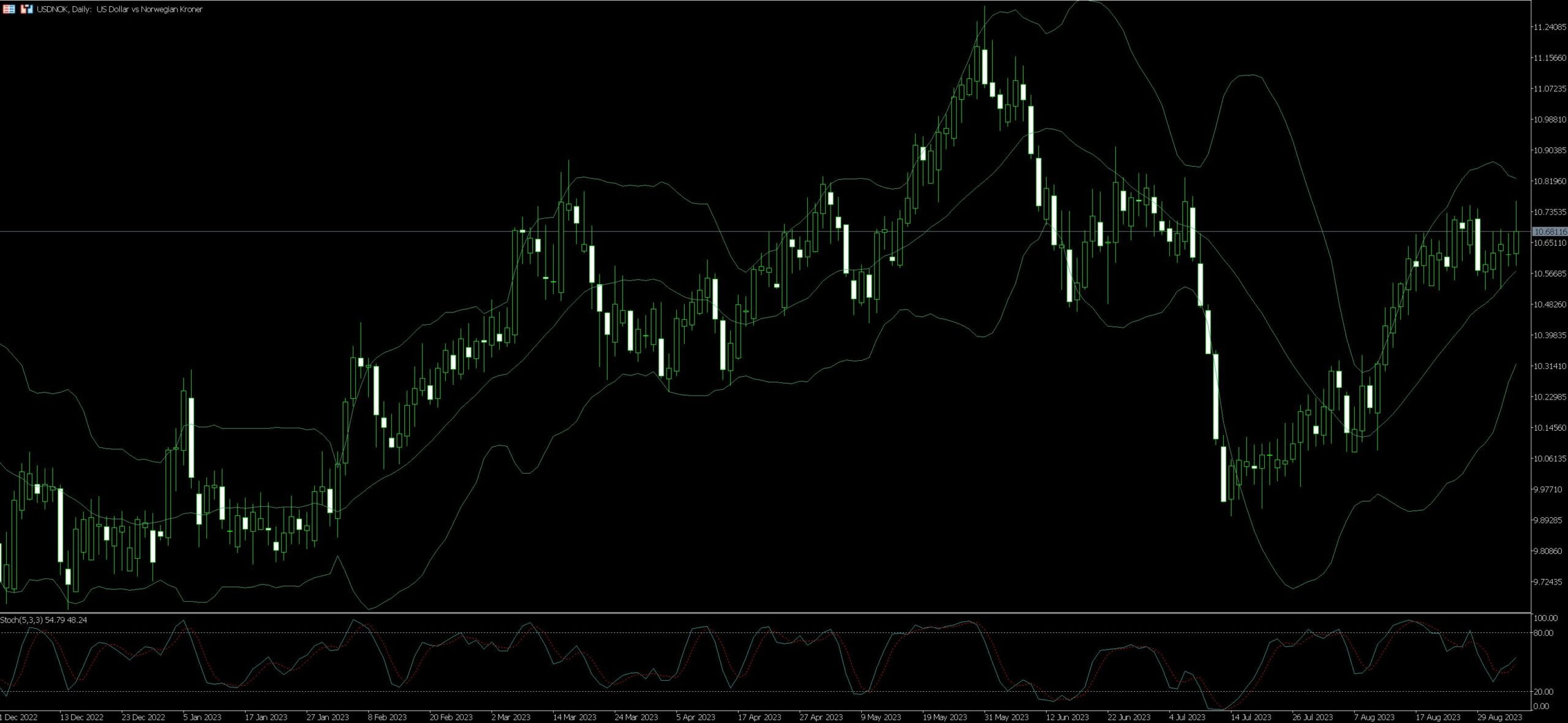
Live Chart Of USD/NOK
1. Understanding USD/NOK Currency Pair
Trading USD/NOK embodies the exchange rate between the United States Dollar and Norwegian Krone. Knowledge about these currencies is crucial as their value is a direct reflection of the economies they represent. Visibility into the US economy is inherent due to the status of the US Dollar as the world’s primary reserve currency. An increase in US interest rates often leads to a stronger USD as global investors reallocate capital to take advantage of higher yields, subsequently affecting the USD/NOK pair.
Norwegian Krone, on the other hand, primarily hinges on the price of crude oil as Norway is a significant exporter. Any fluctuation in oil prices directly correlates to the value of the Krone. It’s equally important to monitor Norway’s interest rates, economic indicators, and political stability, as these too can influence the currency’s strength.
When trading USD/NOK, one must practice a keen understanding of the market fundamentals for both countries. Traders also need to consider the pair’s lower liquidity compared to major pairs, resulting in wider spreads and higher volatility. Utilizing technical analysis, studying price charts and trend patterns, can help in anticipating market movements. Yet, it’s mandatory to be prepared for any abrupt shifts caused by changing oil prices or economic news, which are typical of trading this pair.
Market Hours are a significant factor. As Norway is in the European trading session while the US is part of the North American session, overlapping hours often see increased trading activity and volatility. Traders, therefore, need to be aware of when these two sessions intersect. Always aim for high-efficiency trading adopting a concrete risk management strategy that sets boundaries on potential losses.

1.1. Fundamental Insights of USD/NOK
Trading USD/NOK offers intriguing opportunities and its own set of unique challenges that are shaped by various factors that drive the currency pair’s exchange rate. With a keen understanding of these aspects, traders can enhance their decision-making process when planning strategies in the foreign exchange market. For instance, economic indicators from the United States such as GDP growth rate, unemployment rate, and interest rates significantly impact the USD/NOK exchange rate. A strong US economy typically bolsters the USD, leading to a lower exchange rate.
Conversely, factors influencing the Norwegian economy play an equal role here. The price of crude oil, being Norway’s main export, greatly sways the value of the NOK. When oil prices rise, the NOK generally strengthens, causing the USD/NOK exchange rate to fall. Hence, tracking global oil market trends becomes vital for those trading this currency pair.
Furthermore, external factors such as global geopolitical events have considerable effects on USD/NOK. Resolutions or escalations of global conflicts can trigger volatility in this forex pair as investors seek safe-haven currencies or riskier assets.
The application of forex trading strategies, such as technical analysis or fundamental analysis, and a solid risk management plan are imperative for trading USD/NOK with potential success. Traders should stay informed about economic events and policy changes in both countries, apply relevant trading strategies, and closely observe market trends for effective trading in this pair.
Lastly, the time element in trading cannot be understated. Timing your trades during peak liquidity hours for USD/NOK—when both American and European markets overlap—could provide better pricing and lower transaction costs, benefiting your trading activities. Paying attention to time-zone differences, global events schedules, and liquidity factors will emphasize the importance of timing while engaging in USD/NOK trading.
1.2. The Impact of Oil Price Fluctuations
One of the primary factors that influence the value of USD/NOK currency pair is the fluctuations in oil prices. Given that Norway is one of the world’s largest oil exporters, any major shift in oil prices has a direct impact on the nation’s currency value. Greater demand and higher oil prices typically fosters an upswing for NOK against USD and vise versa. Traders need to keenly monitor global oil prices, as well as geopolitical and economic factors that can impact these prices.
Consider, for instance, a political crisis in the oil-producing regions of the Middle East. Such a situation would most likely result in disrupting the oil supply, increasing the global oil prices. This should, in theory, strengthen NOK against USD. This interconnected relationship between the oil market and the USD/NOK is a significant element to consider in your trading strategy.
Alongside this, the monetary policy decisions taken by the Federal Reserve (Fed) and the Norges Bank also impact the USD/NOK pair. Any change in the interest rates will make a difference. Higher interest rates often lead to a higher yield for a currency and could thus strengthen USD against NOK, or vice versa, depending on which central bank is making changes.
Furthermore, always stay updated with economic data releases, such as GDP, employment rate, inflation rate, and retail sales from both countries. These statistical insights often hint at the future movements of the currency pair. Hence, successful trading not only relies on understanding this intricate web of varying influences but also on deploying this understanding to anticipate potential market movements.
2. Key Trading Strategies for USD/NOK

Delving into the intricacies of the currency cross of United States Dollar (USD) and Norwegian Krone (NOK), there are key strategies that can facilitate proficient trades. The appeal of trading this pair is found in the profound influence of Norway’s economic health, driven by its petroleum industry. Positioning this as the first cornerstone of a trading strategy, an astute trader analyses the global oil market. A direct correlation exists between crude oil prices and the value of the NOK. When crude oil prices surge, the NOK typically appreciates in relation to the USD.
Macro-economic indicators serve as the second pillar of a sound trading strategy. Significant data from the U.S. has the potential to create volatility in the USD/NOK pair. Employment figures, interest rate announcements, and GDP data can shift market sentiment drastically. Traders monitor this data and form strategies around potential fluctuations in trade value.
The itinerary of technical analysis comprehensively completes the trading strategy structure for the USD/NOK pair. This analysis utilizes charts and mathematical rules to determine future price movement based on historical data. For instance, Fibonacci retracement levels could be employed to identify potential reversal points in the market, and the Moving Average Convergence Divergence (MACD) can signal momentum shifts, aiding traders in capturing profitable entries and exits.
Incorporating these key strategies encompasses a holistic approach to trading the USD/NOK pair. Market comprehension based on oil price monitoring, attentiveness to essential macro-economic data, and a robust grounding in technical analysis propels traders to navigate this currency pair astutely and exploit opportunities accruing from its dynamic nature.
2.1. Technical Analysis Approaches
In the complex world of currency exchange, namely USD/NOK in this context, employing a sound Technical Analysis Approach is paramount to sustainable success. The Technical Analysis Strategies primarily consist of methods to examine price movements and trends in the market. It offers the advantage of allowing traders to decipher potential market trends before they occur, so they can adjust their trading strategies accordingly.
A commonly used tactic within technical analysis is the use of charts and various types of graphs. This approach helps traders to visualize market data and discern patterns that may forecast future trends. Such charts can range from simple line graphs to more complex candlestick and Renko charts, each serving a different purpose and showing unique aspects of market activity.
With the moving average tactic, traders get to determine the market’s direction over a specific period. When the current price is above the average, it usually suggests that the market is bullish. Conversely, if the current price is beneath the moving average, that could denote a bearish market.
Another significant tool within technical analysis is the Relative Strength Index (RSI). This index measures the ratio of up moves to down moves and normalizes the calculation. Essentially, the RSI helps traders identify overbought or oversold conditions in the market, giving valuable insight when determining when to enter or exit a position.
Divergence analysis is another captivating approach. Traders look for variances between the price of the asset and the pertinent indicator or oscillator. Divergence may presage potential reversals in the market – invaluable information for any trader.
Some other strategies within technical analysis include the Bollinger Bands and Fibonacci Retracement. These methods provide traders with additional resources to help predict price movement based on historical data and trends, boost efficiency and enhance overall trading performance. Grasping these techniques will further equip traders to successfully navigate the volatile USD/NOK market.
2.2. Fundamental Analysis Approach
The Fundamental Analysis Approach works as a key driver for trading decisions in any foreign exchange, including USD/NOK. In practical terms, this approach involves studying various economic indicators like inflation, interest rates, political stability, and overall economic activity to predict currency movements.
For instance, when it comes to trading USD/NOK, you need to study Norway’s main source of revenue, which is believed to be oil. Any fluctuations in oil prices directly impact NOK. So, a sharp rise in oil prices usually sees an appreciation of the NOK making it an ideal time to sell if you have NOK in hand.
On the other hand, the strength of USD is dependent on US economic activities. Thus, to predict the performance of USD, traders need to keep tabs on indicators such as Nonfarm Payroll figures, Consumer Price Index (CPI), and Gross Domestic Product (GDP). As strong US economic data generally results in a stronger USD, thus, purchasing USD during these periods is advisable.
The fundamental analysis does not limit to these factors only. One must also consider geopolitical events, monetary policy decisions, and geopolitical factors that can cause sudden shifts in currency values. This vast array of information forms the lifeblood of the Fundamental Analysis Approach. You analyse, interpret, and put into play, harnessing the power of economic forces to guide your trading decisions.
3. Risk Management in USD/NOK Trading
Understanding the intricacies of risk management when trading the USD/NOK currency pair should be a priority for traders. This pair moves quickly and is prone to sudden price fluctuations, presenting significant risks for unprepared traders. Utilizing a proper risk-management strategy becomes essential in these scenarios, and it often brings a clear difference between successful trading and regrettable losses.
Knowing your risk tolerance is a prerequisite. It is a personal metric that largely depends on your financial resources, knowledge, experience level, and emotional resilience. Determining a level of risk you are comfortable with will help keep your trading in check. This step is elementary, and it’s also pivotal in creating a trading strategy that suits your profile.
Setting stop-loss orders is another smart way to manage your trading risk. They are basically preset orders to close a trade when the market moves against you by a specific amount. This functions as a safety net and prevents you from losing more than you can afford. Never trade without placing a stop-loss order, especially with volatile pairs like the USD/NOK.
The proper use of leverage is also critical. While leverage can boost the potential returns on your trades, it can equally amplify your losses. When used excessively without considering your risk tolerance, it may lead to significant losses that deviate from your planned risk. Hence, lean towards conservative leverage ratios, unless you have sufficient experience and robust risk metrics in place.
Ultimately, the most significant part of risk management in USD/NOK trading is the regular review and adjustment of your strategies, staying responsive to the dynamic nature of the market. Swift adaptation to the changing conditions and understanding that risk management is a continuous process—not a one-time-setup—will help increase the profitability and longevity of your forex trading career. Remember, preserving one’s capital is as important as making profitable trades when participating in the forex market.
3.1. Importance of Stop-Loss and Take-Profit Orders
With the volatile nature of the USD/NOK trading pair, the use of Stop-Loss and Take-Profit orders becomes crucial. A stop-loss order is a safeguard against potential loss in the event of a market downturn when the value of the currency pair declines unexpectedly. On the other hand, a take-profit order allows traders to capitalize on favourable market movements by closing a position once a certain profit level has been reached.
It’s no secret that the market can shift in a blink of an eye and unexpected changes can cause undesirable results. In this volatile environment, Stop-Loss orders can ensure maximum damage control. These orders automatically close an open position when the currency’s value drops to the set level, mitigating losses. This tool provides relief from the constant need for market monitoring by reducing the risk of human error or emotional trading decisions.
Likewise, the Take-Profit orders help in ensuring a steady flow of gains. The idea is to set a predetermined profit level and once that price point is reached, the order is executed and the position is closed. This method is a great way to cash in gains during high market variability and also curb the temptation of overtrading or price chasing.
Trading USD/NOK can yield significant profits, especially for those who understand market dynamics and how to utilize essential trading tools. Therefore, efficient use of Stop-Loss and Take-Profit orders ought to be part of every trader’s toolkit. Ensure a level-headed approach to trading by protecting investments from negative market swings and securing profits in favourable market conditions.
3.2. Emphasis on Diversification
Spreading the investments across a variety of different assets – that’s the key to successful trading of USD/NOK. Diversification plays a significant role. A trader must not put all eggs in one basket – in this case, just one currency pair. Rather, he must diversify, investing in different currency pairs such as the GBP/JPY or the EUR/USD.
Diversification minimises risk, aiding in the preservation of capital. To make the most out of trading USD/NOK, traders have to diversify to other volatile currency pairs as well. The advantage is that trading different currency pairs can result in achieving optimal balance and reduced risk.
Another way to diversify is by employing different trading strategies. Imagine using scalping for day trading, swing trading overnight, and position trading for longer-term investments. An effective mix of strategies and diversification can potentially lead to increased profitability. Simultaneously, one can hedge current positions, providing a potential safety net from adverse market movements. It also allows traders to benefit from multiple market scenarios. A winning strategy for USD/NOK trading must, hence, emphasise diversification.
Diversification is a tried and tested approach in forex trading. Traders using it for USD/NOK stand to remain unscathed during periods of turbulence, maintaining trading consistency.
When trading USD/NOK, traders must adopt a holistic approach, employing smart risk management, technical analysis and market knowledge, alongside keeping a diversified portfolio. This dynamic is what seasoned traders have mastered. This method not only helps to avoid pitfalls but also to take advantage of unexpected market opportunities.
4. Selecting a Suitable Forex Broker for USD/NOK Trading
Choosing a Forex broker who can service your USD/NOK trading needs requires diligent research and careful consideration. It is important to evaluate the breadth of a broker’s offerings. Ensure that they provide access to the Forex market and the pair USD/NOK for trading. Broker’s ability to provide on-demand analysis tools and up-to-date market news can add substantial value to your trading experience.
Look closely for features such as competitive spreads and credibility. The broker should have competitive spreads on the pair USD/NOK, as this can significantly affect the cost of your trades. Furthermore, make sure the broker is regulated by a robust financial authority. The broker’s trustworthiness and credibility play crucial part.
Customer service and support are another major deciding factors. When trouble strikes – be it a technical issue or a query about a sophisticated investment product – helpful and responsive customer service can save both your time and money.
Additionally, consider the trading platforms offered. This implies both their user interface and the underlying technology. Prioritize brokers offering advanced trading platforms with built-in tools like technical analysis, charting capabilities, and real-time price streaming for USD/NOK pair. It is crucial that these platforms are accessible on multiple devices, desktop or mobile.
Finally, weigh the deposit and withdrawal policies of potential brokers. Ensure that the broker offers a variety of funding methods that are convenient for you. Moreover, it would be beneficial if the broker handles withdrawals swiftly and without any unnecessary hurdles.
In the dynamic world of Forex trading, these factors can make the difference between an optimal trading experience or an underwhelming one. Your choice of Forex broker is a critical determinant of your success in the market.
4.1. Assessing Broker’s Regulatory Status
In the world of trading, the credibility and reliability of a broker can never be overemphasized. Whether you’re trading the United States Dollar (USD) against the Norwegian Krone (NOK) or any other currency pair, conducting a thorough investigation of a broker’s regulatory status falls under your charter of diligence. Regulatory agencies for financial services exist globally to provide a certificate of good conduct and assure traders of a safe, fair and transparent trading environment. They enforce rules and standards that brokers must align with to maintain their licenses. Notable international regulatory bodies include: Financial Conduct Authority (FCA), Commodities Futures Trading Commission (CFTC), Australian Securities and Investments Commission (ASIC), and the Financial Sector Conduct Authority (FSCA) in South Africa.
Prior to assuming a trading relationship with any broker, be it for trading USD/NOK or any other currency pair, be sure to check if the broker is listed and regulated by one of these reputable international bodies. This confirmation can typically be located on the broker’s website, usually found in the “About Us” or “Legal” sections. A broker displaying a license number confirms its alignment with stipulated industry standards, operational transparency, regular audits and adherence to security measures. Consequently, investing your time to access a broker’s regulatory status helps immunize your investments against potential scams, frauds, and unauthorized operations. Be aware that a non-regulated broker can pose significant risks – traders lack protective measures and are open to uncontrolled risk. Therefore, a broker’s regulatory status acts as an endorsement of their trustworthiness, robustness and adherence to both financial and ethical standards. Never compromise on verifying the regulatory status of your chosen broker.
4.2. Evaluation of Trading Platform and Tools
Navigating through the trading platform and mastering its tool-kit becomes the cornerstone of any successful USD/NOK trading relationship. Choice of platform can directly influence the ease of transactions and access to relevant trade information. For this pair, a platform that delivers sharp real-time quotes, advanced charting tools, and places a high emphasis on security come paramount.
Access to a set of robust trading tools is a must for any trader dealing with this currency pair. Tools such as economic calendars, which plan around market-moving events; real-time news updates, keeping traders abreast of vital shifts in market sentiment; and technical analysis tools, which offer insights into market trends and potentials for price movements, can significantly impact reading the market and making informed trading decisions.
Moreover, trade execution becomes vital when dealing with the volatility typical of the USD/NOK pair. Thus, the need for a platform offering fast, reliable trade executions cannot be overemphasized. It becomes all the more critical when paired with trading tools like stop-loss orders – which err on the side of caution by allowing traders to set their maximum losses.
Understandably, user interface and ease of navigation play a crucial role too. A user-friendly platform that allows customization adds an edge to a trader’s strategy, offering a personalized workspace that tailors the tool’s visibility according to individual preference.
Finally, of non-negotiable importance is platform security. With the rising incidents of cyber threats, a platform providing top-notch security measures ensures a secure trading environment. Features to seek include data encryption, two-factor authentication, and regularly performed security audits.
In summary, evaluating a trading platform and its tools involves a careful look at its real-time features, trade execution speed, user interface, customization features, and, most importantly, the level of security it offers.