

1. Understanding Williams %R Indicator
Williams %R operates on the premise that as prices increase, closes tend to occur nearer to the high of the recent price range. Conversely, as prices fall, closes tend to be near the low of the range. This behavior is what the Williams %R seeks to capture, providing traders with a snapshot of where the current price is in relation to its recent range.

Here’s a brief outline of how traders might use the Williams %R in their analysis:
- Overbought/Oversold Conditions: A reading above -20 may indicate that the asset is overbought, while a reading below -80 may suggest it is oversold.
- Divergence: If the asset’s price is making new highs or lows but the Williams %R is not, it could suggest weakening momentum and a potential price reversal.
- Failure Swings: These are considered as strong indications of a market reversal. A failure swing above -20 is bearish, whereas one below -80 is bullish.
Practical Application:
| Market Condition | Williams %R Interpretation | Potential Action |
|---|---|---|
| Overbought (-20) | Suggests selling pressure may increase | Consider taking a short position or exiting a long position |
| Oversold (-80) | Indicates potential increase in buying pressure | Consider entering a long position or closing a short position |
| Divergence | Price and indicator are not confirming each other | Prepare for a possible price direction change |
| Failure Swing | A specific pattern within the indicator’s movements | Confirm with other indicators before taking action |
Adjusting Sensitivity:
Traders may adjust the look-back period to increase or decrease the Williams %R sensitivity. A shorter period will make the indicator more sensitive to price movements, leading to more overbought or oversold readings. A longer period smooths out the oscillator’s movements, providing fewer signals but potentially increasing their reliability.
Combining with Other Indicators:
For a more robust trading strategy, traders often combine the Williams %R with other technical analysis tools. For instance, using trend indicators like moving averages can help confirm the trend direction, while volume indicators can validate the strength behind a move suggested by Williams %R.
Risk Management:
While the Williams %R can be a powerful tool, it’s essential to use it as part of a comprehensive trading plan that includes risk management strategies. Overbought and oversold levels do not automatically mean a price reversal is imminent. Therefore, traders should use stop-loss orders and only risk a small percentage of their trading capital on any single trade.
1.1. Definition and Origin
The Williams %R indicator operates on a simple premise: by comparing the current close to the highest high and the lowest low over a specific period, traders can identify potential reversals in price momentum. The formula for the Williams %R is as follows:
Williams %R = (Highest High - Close) / (Highest High - Lowest Low) * -100
Here, the Highest High refers to the highest price in the look-back period, while the Lowest Low is the lowest price in that same period. The Close is the most recent closing price.
Key levels to watch in the Williams %R are:
- Overbought region: Readings from 0 to -20.
- Neutral zone: Readings between -20 and -80.
- Oversold region: Readings from -80 to -100.
Traders employing the Williams %R might use it in conjunction with other technical analysis tools to confirm signals. For instance, a trader may look for divergences between the Williams %R and price action as a sign of weakening momentum, or use it in tandem with moving averages to determine the strength of a trend.
Practical application of the Williams %R includes:
- Identifying market extremes: When the indicator moves into overbought or oversold territory, it can signal an impending reversal.
- Spotting divergences: If the price makes a new high or low that is not confirmed by the Williams %R, it may indicate a potential price reversal.
- Trade confirmations: A move out of overbought or oversold conditions can confirm other trade signals.
It’s important to note that no indicator is infallible, and the Williams %R is best used as part of a comprehensive trading strategy. False signals can occur, especially in sideways markets where overbought and oversold conditions can persist for extended periods. Therefore, risk management and confirmation from additional indicators are essential components of utilizing this tool effectively.
1.2. Formula and Calculation Method
When utilizing the Williams %R indicator, traders can gain valuable insights into market momentum and potential turning points. Here’s a breakdown of what traders should look for when analyzing Williams %R:
Overbought and Oversold Levels:
- Overbought: Readings above -20 suggest that the market may be overbought. This condition could be a signal that the market is due for a reversal or pullback.
- Oversold: Readings below -80 indicate an oversold market. This could imply that selling pressure is exhausted, and a market turnaround might be near.
Divergences:
- Bullish Divergence: Occurs when the price records a lower low, but the Williams %R sets a higher low. This divergence can be an early sign of a potential upward price movement.
- Bearish Divergence: Happens when the price achieves a higher high, but the Williams %R makes a lower high. This may signal an impending price decline.
Failure Swings:
- Bullish Failure Swing: Takes place when the Williams %R falls below -80, rises back above -80, drops again without reaching -80, and then breaks its prior high. This pattern is seen as a bullish setup.
- Bearish Failure Swing: Occurs when the Williams %R goes above -20, dips below -20, rallies but stays below -20, and then falls below its recent low. This is considered a bearish signal.
Trend Confirmation:
- Traders may use the Williams %R to confirm trends. If the indicator is consistently in the overbought region during an uptrend, it can confirm the strength of the trend. Conversely, persistent oversold readings during a downtrend may confirm a strong downtrend.
Crossing the Midpoint:
- A move from below -50 to above indicates increasing bullish momentum, while a move from above -50 to below can signal growing bearish momentum.
Practical Application:
| Condition | Williams %R Reading | Implication |
|---|---|---|
| Overbought | Above -20 | Potential price reversal |
| Oversold | Below -80 | Possible upward turn |
| Bullish Divergence | Higher low in %R | Upward price movement likely |
| Bearish Divergence | Lower high in %R | Downward price movement likely |
| Bullish Failure Swing | Sequence: Below -80, above -80, not reaching -80, break prior high | Bullish setup |
| Bearish Failure Swing | Sequence: Above -20, below -20, not exceeding -20, fall below recent low | Bearish setup |
Williams %R can be a powerful tool in a trader’s arsenal, but it’s important to use it in conjunction with other technical analysis tools and methods. As with all indicators, it’s not foolproof and is best used as part of a comprehensive trading strategy.
Chart Analysis:
- Traders should also look at chart patterns and other indicators to confirm signals provided by Williams %R.
- Support and Resistance Levels: Comparing Williams %R peaks and troughs with price action can provide additional insights.
By understanding and effectively applying the Williams %R indicator, traders can better time their entry and exit points, manage risk, and identify potential trends in the market. However, reliance on any single indicator is not recommended; cross-verification with other technical tools can enhance trading decisions.
1.3. Overbought and Oversold Levels
Incorporating the Williams %R indicator into a trading strategy involves more than just recognizing the overbought and oversold levels. Effective use of this tool requires a nuanced approach, blending it with other forms of technical analysis to confirm signals and manage risk.
Integration with Other Indicators
- Moving Averages: A trader might wait for the Williams %R to indicate an oversold condition and then look for the price to cross above a moving average to confirm a bullish signal.
- Volume Indicators: An oversold signal on the Williams %R could be confirmed with an increase in volume, suggesting stronger buyer interest.
- Trend Lines: Breakouts or bounces from trend lines in conjunction with Williams %R signals can provide additional confirmation of a trade entry or exit.
Risk Management
- Stop-Loss Orders: When entering a trade based on Williams %R signals, setting a stop-loss can help limit potential losses if the market moves against the position.
- Position Sizing: Adjusting the size of a trade based on the strength of the Williams %R signal and the confluence of other indicators can help manage risk.
Example of a Trading Scenario:
| Condition | Williams %R Signal | Additional Confirmation | Action |
|---|---|---|---|
| Overbought | Crosses below -20% | Price breaks below a support level | Consider selling or shorting |
| Oversold | Crosses above -80% | Price breaks above a resistance level | Consider buying or going long |
Advanced Techniques:
- Multi-Timeframe Analysis: Traders may look at Williams %R readings on multiple timeframes to gauge both short-term and long-term market sentiment.
- Channel Trading: When prices are trading within a range, the Williams %R can help identify potential tops and bottoms as prices oscillate between support and resistance.
By combining the Williams %R with a thorough understanding of market structure and other technical tools, traders can enhance the effectiveness of their trading decisions. Continuous learning and adaptation to market conditions are paramount for traders aiming to utilize the Williams %R indicator successfully.
2. Trading Strategies Using Williams %R
Understanding the Williams %R Readings
| Williams %R Value | Market Condition |
|---|---|
| Above -20 | Overbought |
| Below -80 | Oversold |
| Between -20 & -80 | Neutral |
Buy and Sell Signals with Williams %R
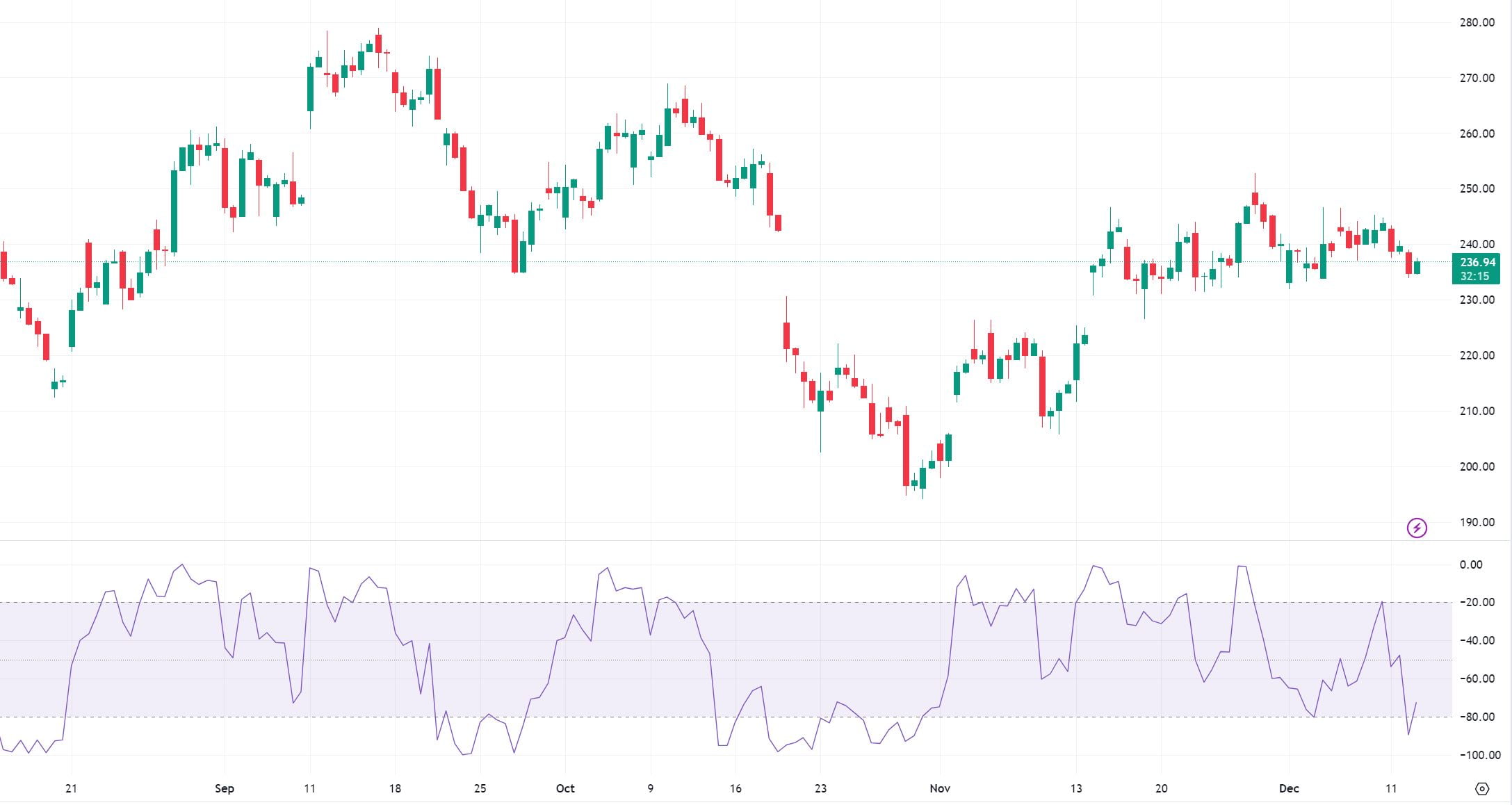
- Buy Signal: When Williams %R crosses above -80, it suggests that the market may be moving from an oversold condition back to a neutral state, which could be a buying opportunity.
- Sell Signal: Conversely, when the indicator falls below -20, it indicates a potential shift from overbought to a neutral market condition, which could be a selling point.
Combining Williams %R with Moving Averages
- Confirmation of Trend: Use a moving average to confirm the trend direction suggested by Williams %R.
- Entry Point: Williams %R provides the specific entry signal.
- Trend Strength: The moving average can indicate the strength and stability of the trend.
Risk Management with Williams %R
- Stop Loss: Place stop loss orders just past the most recent price high or low before the trade signal.
- Take Profit: Set take profit targets at historical support and resistance levels or use a predetermined risk-reward ratio.
Risk-Reward Ratio Consideration
- Aim for a minimum risk-reward ratio of 1:2.
- This ensures the potential profit is at least double the potential loss on every trade.
By carefully monitoring Williams %R values and integrating additional technical analysis tools, traders can make more informed decisions that align with their trading strategies and risk management principles.
2.1. Identifying Trend Reversals
Williams %R, also known as Williams Percent Range, is a type of oscillator used in technical analysis that reflects the level of the close relative to the highest high for the look-back period. Here are some critical points to consider when using the Williams %R indicator:
- Overbought and Oversold Levels: The indicator moves between 0 and -100, with readings above -20 typically considered overbought and readings below -80 considered oversold.
Thresholds for Williams %R
| Overbought Level | Oversold Level |
|---|---|
| Above -20 | Below -80 |
- Crossover Signals: A crossover above the -80 level may signal a bullish reversal, while a crossover below the -20 level may signal a bearish reversal.
Crossover Points for Williams %R
| Bullish Signal | Bearish Signal |
|---|---|
| Above -80 | Below -20 |
- Divergences: A divergence occurs when the price records a higher high or lower low that is not confirmed by the Williams %R. This can be an early warning of a potential trend reversal.
Types of Divergences with Williams %R
| Bullish Divergence | Bearish Divergence |
|---|---|
| Indicator higher low, Price lower low | Indicator lower high, Price higher high |
- Confirmation: It’s crucial to combine Williams %R with other indicators to filter out false signals and improve the reliability of the signals.
Confirmation Tools
| Trend Confirmation | Volume Confirmation |
|---|---|
| Moving Averages | Volume Oscillators |
By paying attention to these aspects, traders can leverage the Williams %R indicator to enhance their trading strategy and better manage entry and exit points in the markets. Remember, no indicator is foolproof, and combining various technical tools can provide a more comprehensive view of market conditions.
2.2. Combining with Other Technical Indicators
Combining Williams %R with Other Indicators
| Indicator Type | Purpose | Combination with Williams %R |
|---|---|---|
| Trend-Following Tools | Confirm trend direction | Use moving averages to identify potential buy/sell signals when Williams %R indicates oversold/overbought conditions |
| Momentum Oscillators | Measure the speed of price changes | Pair with RSI or Stochastic Oscillator for confirmation of overbought/oversold conditions |
| Volume Indicators | Validate the strength of a trend | On-Balance Volume (OBV) can confirm or question the signals from Williams %R, especially in divergences |
| Chart Patterns & Price Action | Identify key structures and price movements | Look for breakouts that coincide with Williams %R signals for stronger trade setups |
Strategic Implementation
- Moving Averages: When the Williams %R indicates oversold and the price is above a moving average, it suggests a potential uptrend continuation. Conversely, an overbought signal with price below a moving average might hint at a downtrend continuation.
- Momentum Oscillators: Confirming overbought or oversold conditions with another oscillator like the RSI can reduce the likelihood of false signals. Traders may wait for both indicators to align before making a trade decision.
- Volume Indicators: A divergence where the Williams %R indicates a potential reversal (oversold or overbought) but the OBV shows decreasing volume can imply a lack of conviction in the price move, urging caution.
- Chart Patterns: Signals from Williams %R can be particularly powerful when they occur in conjunction with price breaking out from chart patterns such as flags, pennants, or wedges.
Key Considerations for Traders
- Redundancy: Ensure indicators provide complementary information to avoid overconfidence in weak signals.
- Market Conditions: Adapt the combination of tools based on the prevailing market environment and asset volatility.
- Validation: Use additional indicators to validate Williams %R signals, reducing the risk of trading on noise.
Practical Usage
- Before executing a trade based on the Williams %R, check for confirmation from at least one other technical tool.
- Monitor multiple time frames to ensure signals are consistent across short, medium, and long-term charts.
- Always consider the context of the overall market and sector performance when interpreting signals from the Williams %R and its complementary indicators.
By thoughtfully integrating the Williams %R with other technical analysis tools, traders can enhance their decision-making process and strive for better trade outcomes.
2.3. Setting Stop Loss and Take Profit Points
Williams %R Indicator: A Tool for Timing Trade Exits
The Williams %R indicator is a momentum oscillator that can be instrumental in determining optimal exit points in trading scenarios. By oscillating between 0 and -100, this indicator provides traders with signals that can be used to gauge overbought and oversold conditions.
Stop Loss Points:
- Overbought Condition: In a downtrend, place a stop loss just above the most recent high when Williams %R suggests the market is overbought.
- Oversold Condition: In an uptrend, position a stop loss below the most recent low when Williams %R indicates an oversold market.
These stop loss placements help protect against market reversals following overextended price movements.
Take Profit Points:
- Short Positions: Consider setting a take profit order around the -80 level, as this may signify the start of an oversold condition.
- Long Positions: A take profit order near the -20 level could be advantageous, indicating an overbought condition.
It’s not just about setting static levels; adjusting these points is critical. Traders should evaluate the historical performance and volatility of the asset they are trading to determine the most effective levels for stop loss and take profit orders.
Backtesting for Enhanced Precision:
- Historical Data Analysis: Backtest strategies using historical price data to refine stop loss and take profit levels.
- Volatility Assessment: Adjust levels to account for the asset’s typical price movements and volatility.
Risk Management with Williams %R:
Utilizing the Williams %R for risk management ensures that traders maintain a disciplined approach to exiting trades. Whether to realize profits or to cut losses, the use of this indicator can provide structured and strategic exit points. By integrating the Williams %R into their trading plan, traders can navigate the markets with a clear framework for when to exit positions.
3. Practical Tips for Applying Williams %R
The Williams %R indicator, developed by Larry Williams, is a momentum indicator that measures overbought and oversold levels, similar to the Stochastic Oscillator. Here’s how to apply it effectively:
Time Frame Selection
- Short-term traders:
- 1 to 14 days time frame
- Captures quick price movements
- Ideal for scalpers and day traders
- Long-term traders:
- 15 to 30 days time frame
- Smoothens out short-term fluctuations
- Suitable for swing traders and investors
Sensitivity Adjustment
- Volatile market conditions:
- Use a higher period setting (e.g., >14)
- Reduces sensitivity to avoid false signals
- Trending market conditions:
- Use a lower period setting (e.g., <14)
- Increases sensitivity for timely entries/exits
Best Practices for Williams %R
- Combine with other indicators:
- Use alongside moving averages, RSI, MACD
- Strengthens the validity of trading signals
- Beware of false signals:
- Watch for divergences between price and Williams %R
- Wait for confirmation from price action or other indicators
- Contextual analysis:
- Consider overall market trends and news
- Align Williams %R signals with market sentiment
By adhering to these guidelines, traders can utilize the Williams %R indicator to make more informed trading decisions and potentially increase their chances of success in the markets. It’s essential to continuously monitor and adjust settings as market conditions change.
3.1. Choosing the Right Time Frame
When integrating the Williams Percent Range Indicator into a trading strategy, understanding its functionality across various time frames is essential. This oscillator is designed to identify overbought and oversold levels, which can signal potential reversal points in the market. However, the effectiveness of these signals can be heavily influenced by the time frame selected.
Time Frame Considerations for Different Trading Styles:
- Day Traders:
- 1-Minute to 15-Minute Charts: Ideal for capturing quick, intraday price movements.
- High Frequency of Signals: More opportunities for trade entries and exits.
- Increased Risk of False Signals: Due to market noise and short-term volatility.
- Swing Traders:
- 1-Hour to 4-Hour Charts: Suitable for trades that last several days to a few weeks.
- Moderate Frequency of Signals: Balances responsiveness with signal reliability.
- Potential for Timely Entries: Allows for catching significant swings in price.
- Long-Term Investors:
- Daily to Weekly Charts: Best for analyzing long-term trends and broader market shifts.
- Lower Frequency of Signals: Provides a more filtered view of the market.
- Delayed Response to Market Changes: Signals are less sensitive to short-term fluctuations.
Advantages and Disadvantages Based on Time Frame:
| Time Frame | Advantages | Disadvantages |
|---|---|---|
| Short | Quick signals for fast trades. | Higher risk of false positives. |
| Medium | Balance between signal quality and quantity. | May miss very short-term opportunities. |
| Long | Reduced noise and clearer trends. | Slower to react to market changes. |
Strategies for Optimal Use:
- Backtesting: Apply the Williams %R to historical data to evaluate performance.
- Combination with Other Indicators: Use alongside trend-following tools or volume indicators for confirmation.
- Adjustment of Parameters: Modify the look-back period to fine-tune the sensitivity.
Traders must test and adapt the Williams %R settings to align with their market analysis and risk tolerance. It’s not just about choosing the right time frame, but also about how it integrates with the overall trading approach and the market conditions being traded. Flexibility and adaptation are key to harnessing the full potential of this indicator.
3.2. Adjusting Sensitivity to Market Conditions
Understanding the nuances of the Williams Percent Range Indicator (Williams %R) is crucial for traders who wish to leverage its capabilities. Here’s a comprehensive breakdown of how to fine-tune the indicator to various market conditions:
Adjusting Williams %R for Different Market Conditions
- High Volatility Markets
- Shorten the look-back period to capture rapid price movements.
- Be prepared for a greater number of overbought/oversold signals.
- Filter out false signals with additional confirmation from other indicators or price patterns.
- Low Volatility, Trending Markets
- Lengthen the look-back period to reduce sensitivity and smooth the indicator.
- Focus on clear, sustained overbought/oversold readings that align with the trend.
- Use in conjunction with trend-following strategies to reinforce trade signals.
Dynamic Adjustment Using Average True Range (ATR)
- Calculate ATR to determine the current market volatility.
- Set the Williams %R look-back period based on ATR readings:
- Lower ATR values might suggest a longer look-back period.
- Higher ATR values could indicate the need for a shorter look-back period.
Continuous Monitoring and Adjustment
- Regularly review the market conditions and adjust the Williams %R settings accordingly.
- Backtest different settings to find the optimal look-back period for current market dynamics.
- Combine Williams %R with other technical tools to validate signals and reduce the risk of false positives.
By meticulously adjusting the Williams %R indicator to match the market’s rhythm, traders can enhance their analytical precision and bolster their decision-making process. It’s a matter of striking the right balance between responsiveness to market moves and the avoidance of misleading signals a balance that can only be achieved through experience, vigilance, and a deep understanding of market volatility.
3.3. Avoiding Common Pitfalls
Understanding Williams %R in Context
The Williams Percent Range Indicator, commonly known as Williams %R, is a momentum indicator that measures overbought and oversold levels, similar to the Stochastic Oscillator. Here are some key considerations when using Williams %R:
- Market Context: Always analyze the broader market trend before relying on Williams %R. In a trending market, the indicator can remain in overbought or oversold territory for extended periods, which might not necessarily signal a reversal.
Risk Management Essentials
- Stop Loss Settings: Integrate Williams %R with other technical analysis tools to set more accurate stop loss levels. The indicator alone does not indicate where the price might stop and reverse.
- Position Sizing: Adjust your position size based on the confidence level of the signal and your overall risk management strategy.
Avoiding Over-Optimization
- Historical Data: Be cautious when backtesting Williams %R settings on past data. A setup that worked well in the past may not necessarily work in the future due to changing market conditions.
- Simplicity: Sometimes, the default settings (usually a 14-period lookback) are sufficient. Overcomplicating the settings can lead to confusion and ineffective trading decisions.
Volume Analysis Integration
- Volume Confirmation: Use volume indicators to confirm the signals provided by Williams %R. High volume on an overbought or oversold signal can add confidence to the potential reversal.
- Divergence: Look for divergences between the Williams %R and volume. If the indicator shows overbought but volume is increasing, it might not be a true sell signal.
Practical Tips for Using Williams %R
- Combine with Chart Patterns: Incorporate support and resistance levels, chart patterns, and trend lines to validate Williams %R signals.
- Time Frame Analysis: Consider using multiple time frames to gain different perspectives. For instance, a signal on a weekly chart may have more significance than on a 15-minute chart.
- Sentiment Analysis: Be mindful of the overall market sentiment and news that could affect the asset’s price movement, which Williams %R does not account for.
Adapting to Market Conditions
- Trending vs. Ranging Markets: Adapt the use of Williams %R depending on whether the market is trending or ranging. In a range-bound market, the indicator might be more reliable.
- Volatility: Be aware of the market’s volatility. During high volatility periods, the Williams %R might produce more false signals.
By being mindful of these aspects and integrating other analytical tools, traders can more effectively utilize the Williams Percent Range Indicator to enhance their trading decisions without falling into common traps.